


After the Munch museum, we headed somewhere that costs nothing and stays open day and night, all year round: Vigeland Park, the best-known part of Oslo’s larger Frognerparken. One stop on our June 2026 trip, and one you can walk through without a watch or an opening time to worry about.
The park owes everything to one man, Norwegian sculptor Gustav Vigeland. In exchange for a studio and housing provided by the city of Oslo, he spent nearly twenty years, from 1924 until his death in 1943, filling the park with more than two hundred sculptures in bronze, granite and wrought iron, all built around the cycle of human life. You come across babies, couples, the elderly, whole families frozen in stone, with barely two figures alike.


Statues as far as the eye can see
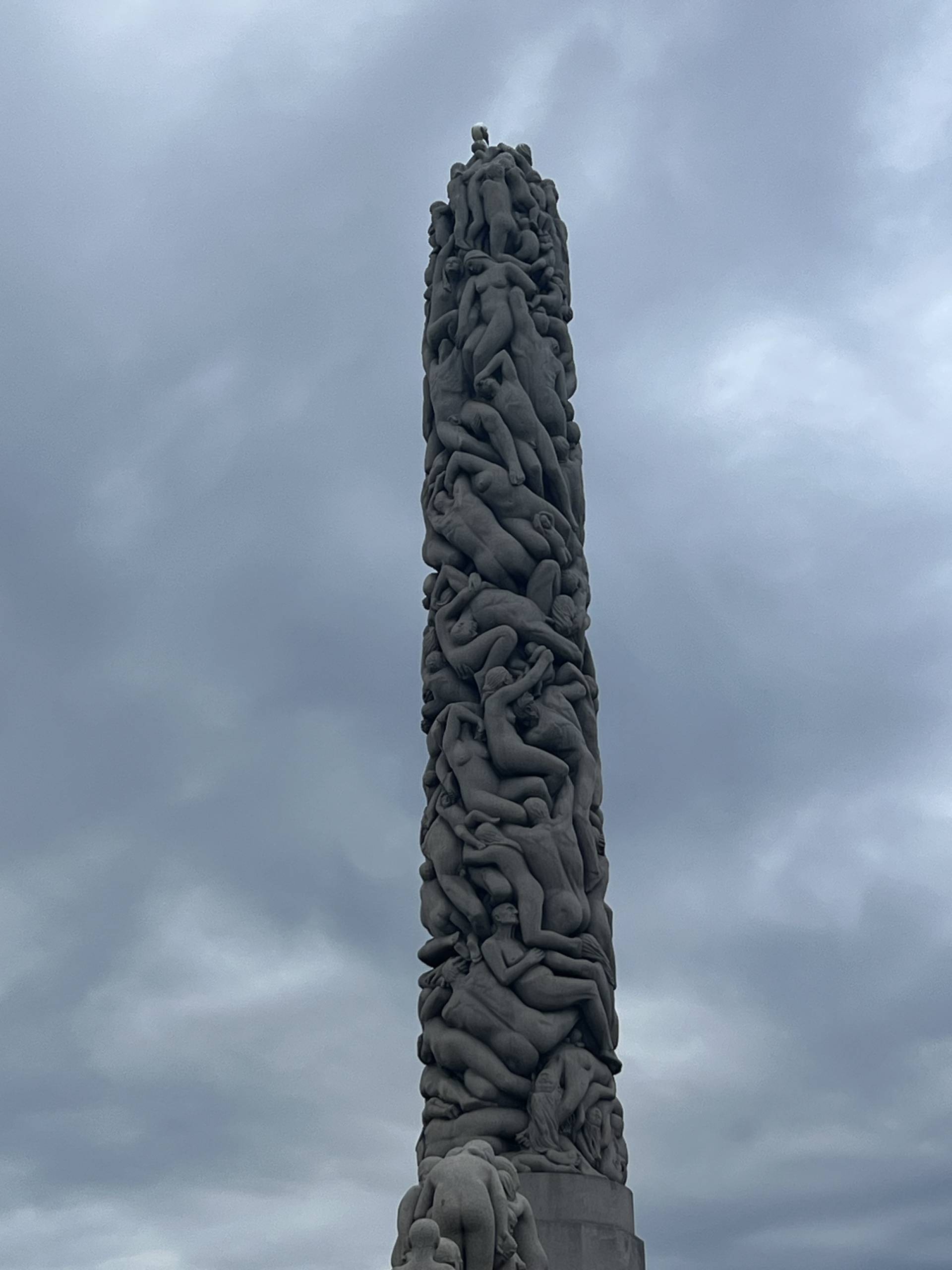
The route follows a fairly natural line: the bridge first, home to Sinnataggen, the “Angry Boy,” fists clenched and mouth wide open mid-tantrum. Then comes the great fountain, followed by a staircase leading up to the Monolith plateau, a 14-metre granite column carved with 121 intertwined bodies that seem to be climbing toward the sky. All around it, the Wheel of Life closes the symbolic loop of the walk.
Good to know

Don’t miss
Plenty of visitors still touch Sinnataggen’s hand for luck. The Vigeland Museum now advises against it: the bronze wears down and dulls over the years from being rubbed by thousands of hands. Better to settle for a photo and spend that time climbing up to the Monolith instead, the real high point of the visit.
What our daughter loved
She loves parks, so after several hours of flying from Bordeaux, she loved this walk, especially coming out of a heatwave back home. We had plenty of conversations about the strangest statues along the way.
The real upsides for kids

If your kids are older
The contrast between the sculptures, from infants to the elderly, opens up an easy conversation about the cycle of life without ever feeling heavy. Climbing up to the Monolith and counting the intertwined figures quickly turns into a little game.
If your kids are under 8
The park is huge and very green, with wide paths where they can run around safely. Sinnataggen, with his angry face, is usually the sculpture that sticks with younger kids the most. Bring something for a picnic on the grass, there’s plenty of room for it.
Gallery




Vigeland Park: FAQ
Is entry to Vigeland Park paid?
No, entry is completely free, with no booking or ticket required.
What are the opening hours?
The park is open all year round, 24 hours a day.
How much time should you set aside for the visit?
Budget one to two hours to see the main sculptures, and up to three hours if you add a picnic break or a longer walk through Frognerparken.
How do you get to Vigeland Park?
Tram 12 from Jernbanetorget drops you right at the main entrance, at the Vigelandsparken stop, about twenty minutes from the city centre. By metro, Majorstuen station is around a 10-minute walk away through the Frogner district.
Should you really touch Sinnataggen’s hand?
The Vigeland Museum advises against it. It’s become a recent tourist tradition, but repeated contact damages the statue’s bronze.
How many sculptures are on display in the park?
More than two hundred of Gustav Vigeland’s sculptures are on display outdoors, out of the 650 works and drawings he created for the park in total.
Practical Information
Details
Vigelandsparken Nobels gate 32, 0268 Oslo, Norway
Open all year round, 24 hours a day. Free admission.